The Spring Walk-Around Every Massachusetts Homeowner Should Do
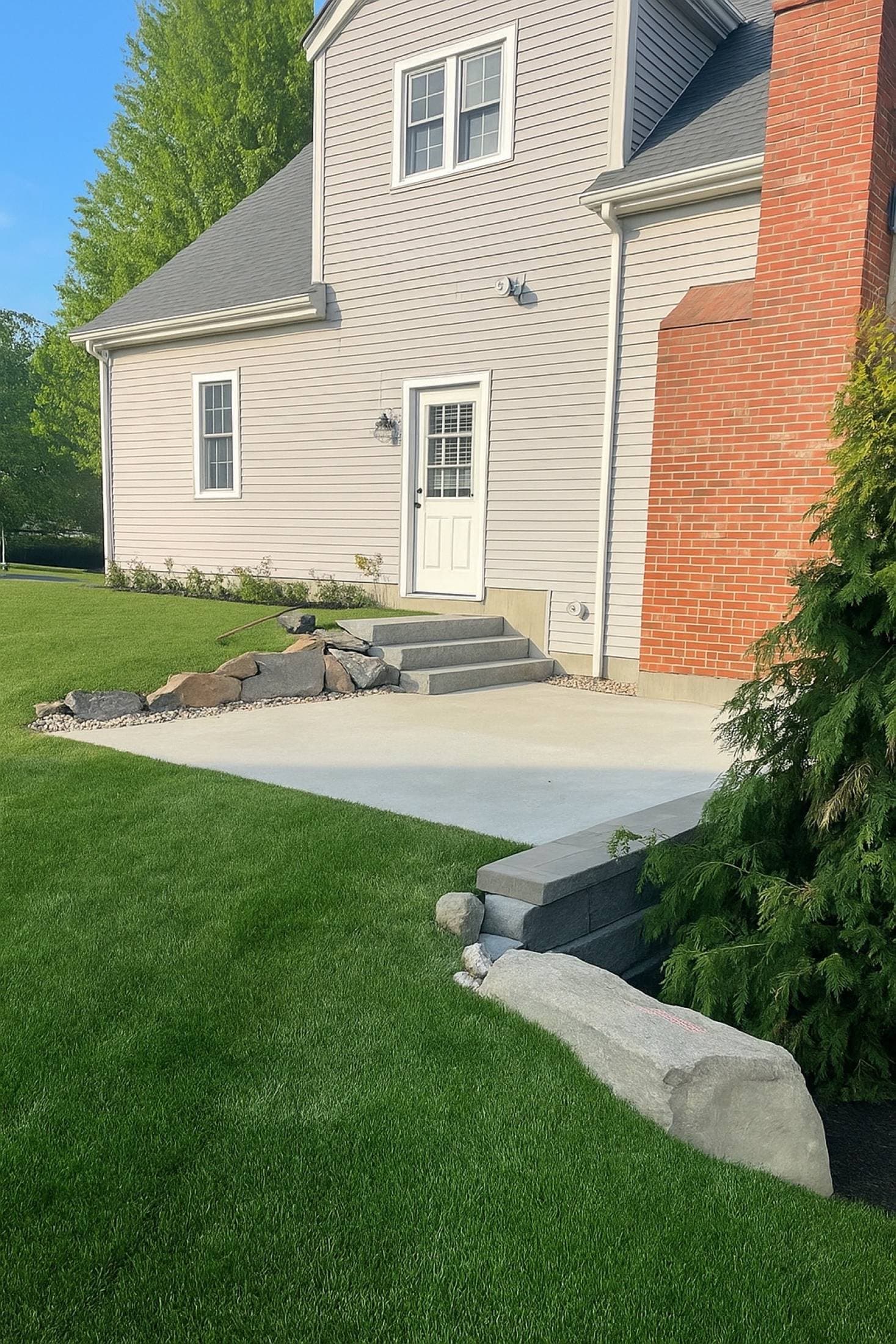
Sometime in late March or April, after the last snowbank finally disappears, take a slow lap around your property and really look at your stonework. The front steps. The walkway. The retaining wall along the driveway. That's when winter presents its bill.
A loose tread that rocked slightly last fall now shifts underfoot. Mortar joints that were merely weathered have opened into gaps. The face of a bluestone step is flaking away in thin sheets. A retaining wall that used to stand plumb now has a subtle lean you can't unsee. None of this happened overnight — it happened over roughly a hundred freeze-thaw cycles between November and March, quietly, under the snow.
The good news: nearly all of it is fixable, most of it is preventable from recurring, and spring is precisely the right time to deal with it. This guide explains how winter actually damages masonry in our climate, how to tell cosmetic wear from structural trouble, and how to think about the repointing-versus-rebuild decision when the damage runs deeper.
How Winter Breaks Stone: Freeze-Thaw and Salt
The Freeze-Thaw Engine
The mechanism is the same one that cracks Massachusetts roads every winter. Water finds its way into every available space — hairline cracks in mortar, the pores of stone and concrete, the joints between steps, the soil behind a retaining wall. When temperatures drop below freezing, that water expands roughly 9 percent, and it expands with tremendous force. Cracks widen. Joints loosen. Flakes of stone shear off.
Then it thaws, and the now-slightly-larger crack admits slightly more water — and freezes again. A typical eastern Massachusetts winter delivers dozens of these cycles, and coastal South Shore towns, where temperatures hover around freezing rather than locking in a deep freeze, often see *more* cycling than colder inland areas. Each cycle is small. The accumulation is not. Freeze-thaw is patient, and it always works from the smallest existing flaw outward — which is why a $300 repointing job ignored for three winters becomes a $3,000 rebuild.
Salt Makes Everything Worse
Deicing salt keeps your steps safe in January and quietly attacks them the rest of the year. Salt damages masonry three ways: it lets water melt and refreeze more times per winter (more cycles), it draws moisture into stone and concrete and crystallizes inside the pores (a slow internal wedging called salt scaling), and it chemically attacks the cement binder in mortar and concrete. The signature of salt damage is spalling — the surface of concrete or stone flaking, pitting, or peeling away in layers, usually worst within a few feet of wherever the salt bucket gets used.
Natural granite shrugs off salt fairly well. Bluestone, concrete steps, and mortar joints do not. If your entry steps look "dissolved" at the edges while stonework farther from the door looks fine, salt is your culprit — worth remembering next winter, when sand or a calcium-magnesium blend near the masonry would be the kinder choice.
The Triage Guide: Cosmetic, Maintenance, or Structural?
Not every scar from winter is urgent. Here's how we'd have you sort what you find on that spring walk-around.
Cosmetic — watch it, fix it when convenient
- Minor surface flaking or pitting on treads and walk surfaces
- Hairline cracks in mortar joints that haven't opened or let pieces move
- Efflorescence — the white, chalky mineral haze left when water moves through masonry and evaporates
- A single walkway stone that has settled slightly proud or low of its neighbors
These don't threaten the structure. They do tell you water is moving where it shouldn't, so they belong on this year's maintenance list, not the someday list.
Maintenance — schedule a repair this season
- Open or crumbling mortar joints you can rake out with a finger
- A step tread or wall cap that rocks, slides, or has come loose from its bed
- Multiple walkway stones heaved out of plane — a genuine trip hazard, and a sign the base beneath them is moving water poorly
- Spalling that has exposed aggregate on concrete steps or is deepening year over year
Loose caps and treads deserve special urgency for one reason: safety. A rocking front step is an injury waiting for a delivery driver or a visiting parent, and it's usually a quick professional fix — reset in fresh mortar or a proper setting bed — when caught early.
Structural — get a professional evaluation now
- A retaining wall leaning, bulging, or bellying outward anywhere along its face
- Stair-step cracking running diagonally through a block or mortared wall
- Steps pulling away from the house or porch, or an entire stair unit tilting
- Soil washing out beneath a walk or from behind a wall after storms
- Gaps opening between a wall and the ground it retains
These are not sand-and-patch problems. They mean the system behind the visible stone — footing, base, or drainage — is failing, and they get more expensive with every season of delay.
Why Spring Is Repair Season
There's a practical rhythm to masonry work in New England, and it favors acting soon after the damage reveals itself:
- The damage is at its most visible. Fresh cracks and winter movement are obvious in April; by July, frost heave partially relaxes, plantings fill in, and problems literally hide until they're worse.
- Mortar wants moderate weather. Repointing and setting work cure best in the mild, damp conditions of spring and early summer — not in freezing temperatures, and not in baking July heat that dries mortar too fast.
- You get the repair before the season you use the space. Fixing the patio steps in May beats losing August to the project.
- This year's repair prevents next winter's escalation. Every open joint sealed in June is one less water entry point when the freeze-thaw engine restarts in December.
Repointing vs. Rebuild: How the Decision Actually Gets Made
For mortared steps, walls, and walkways, most repairs come down to one question: is the structure sound and only the joints failing, or has the structure itself moved?
Repointing — raking out deteriorated mortar to proper depth and packing in fresh mortar — is the right call when the stones or blocks are still where the mason left them: no leaning, no bulging, no settling, just tired joints. Done well, repointing restores both weather-tightness and appearance and can extend a wall or stair's life by decades. Done poorly (a smear of caulk or surface "buttering" over failed joints), it's cosmetic theater that traps water inside and accelerates the failure. Depth matters; matching the mortar matters.
Partial rebuild makes sense when a defined section has failed — the top three courses of a wall, one flight of steps, a wall cap — but the footing and the majority of the structure remain true. The failed section is documented, dismantled, and relaid, often reusing most of the original stone.
Full rebuild is the honest answer when the problem lives below the stone: an undersized footing, a base that was never deep enough for our frost, or — most common of all with retaining walls — no functioning drainage behind the wall. Rebuilding to modern standards means proper excavation, compacted structural base, crushed-stone backfill, perforated drain pipe, and filter fabric. It costs more than patching, and it's the last time you'll pay for that wall.
A useful rule of thumb: if the face is out of plane, repointing alone won't save it. Mortar is not glue strong enough to hold back moving earth.
When a Wall Is Telling You It's Failing
Retaining walls rarely collapse without warning. They announce themselves, sometimes for years, and the vocabulary is consistent:
- Leaning or rotating past vertical — the wall is losing its argument with the soil behind it
- Bulging in the middle courses — hydrostatic pressure from water trapped behind the wall, almost always a drainage failure
- Stair-step cracks tracking diagonally through joints — differential settlement in the footing
- Blowouts or displaced units after heavy rain or a thaw
- Constantly wet wall faces or moss lines — water moving through the wall instead of being drained away from it
Water is behind nearly all of it. In Massachusetts, a retaining wall is really a drainage system wearing stone. When a client shows us a bulging wall, the first question is never about the blocks — it's about where the water behind them is supposed to go. If your wall is showing any of these signs, have it evaluated this season; a leaning wall over a driveway, walkway, or patio is a genuine safety issue, and early intervention often means rebuilding a section rather than the whole run.
Give Winter Less to Work With Next Year
The maintenance loop is simple and worth writing down: walk the property each spring, seal and repoint open joints before winter, redirect downspouts and grade away from stonework, and go easy on the rock salt near masonry. Stonework that sheds water instead of storing it can last generations in this climate — there are two-hundred-year-old walls all over New England proving the point.
If this spring's walk-around turned up rocking treads, crumbling joints, or a wall that's started to lean, Hynes Landscaping can help you sort cosmetic from structural and fix it properly — we've been building and repairing hardscapes across the South Shore and Greater Boston for over 25 years. Learn more about our Hardscapes & Masonry work and our engineered Retaining Wall services, or call us at 781-356-3311 to schedule an evaluation. Winter already did its work this year. Spring is when you get to answer.